
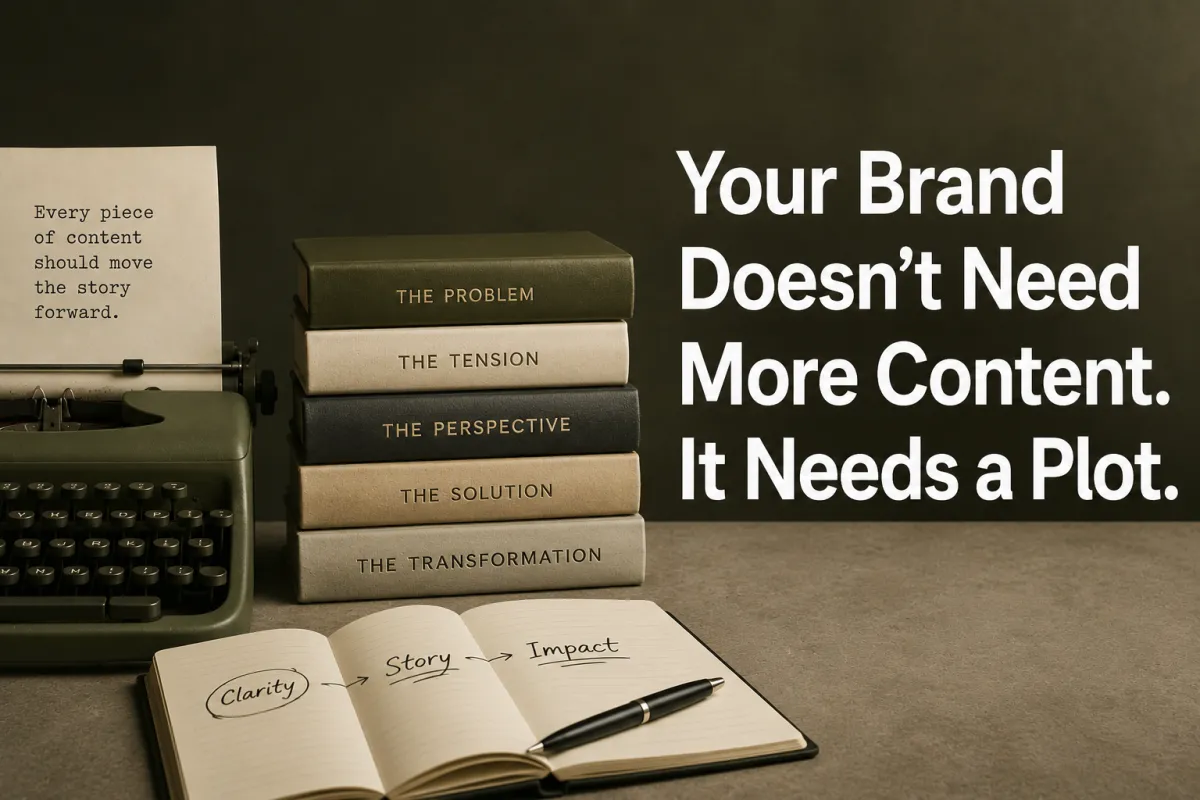
Your Brand Doesn’t Need More Content. It Needs a Plot.
A lot of companies think they have a content problem.
They feel they need to post more. Publish more. Send more emails. Show up more consistently. Maybe launch a newsletter. Maybe finally turn the founder’s ideas into a steady stream of thought leadership. And sometimes that’s true. Consistency matters. The market needs to hear from you more than once before it understands who you are and why you matter.
But a lack of content isn’t always the real problem. Sometimes the real problem is that the content has no plot.
The company is saying things — useful things, even. Updates, insights, case studies, the occasional opinion, a few “thought leadership” pieces that are really service descriptions in disguise. But it doesn’t add up to anything. No arc. No central tension. No point of view strong enough to organize the ideas. No sense that the brand is taking the reader somewhere. That’s why more content so often fails to create more momentum. Volume doesn’t solve a story problem.
Most brand content is fine and forgettable
This is the uncomfortable truth about a lot of B2B content. It’s not bad. It’s competently written, professionally designed, reasonably useful. It explains things. It makes the company look active.
But it doesn’t make the company more memorable. Content can be accurate and still be forgettable. It can be polished and still feel interchangeable. It can be frequent and still fail to build any gravity. The issue is rarely sentence-level quality. It’s narrative structure. Most companies create content as a collection of topics. They ask, “What should we post this week?” That’s a reasonable question, but it isn’t enough. The stronger question is: what story are we trying to make the market believe over time?
How a narrative-driven content strategy gives your brand a plot.
When I say a brand needs a plot, I don’t mean it should turn itself into a movie. I mean it needs a clear narrative logic — something that creates movement, stakes, and a reason to keep paying attention.
In a business, the plot is built around the shift you believe your audience needs to make. From what to what? From confusion to clarity. From ad-hoc marketing to repeatable systems. From founder dependency to scalable messaging. From scattered content to a coherent point of view. From “we know we do good work” to “the market understands why we matter.”
That movement is the real story. Without it, content is a list of disconnected ideas. With it, every piece becomes part of a larger argument. You’re not just posting. You’re building belief.
Every strong brand story has tension
A plot needs tension. Not manufactured drama. Not the kind of marketing language that turns every minor inconvenience into a crisis. Real tension — the gap between where the audience is and where they need to go.
For a growing company, the tension might be that the product has outgrown the story. Early customers understand the value; the broader market doesn’t. The founder can sell the company in conversation, but the website can’t. For another company, the tension is that they’re doing plenty of marketing, but none of it compounds because the positioning underneath is unclear.
The best content doesn’t avoid that tension. It names it. When someone reads your work and thinks, “Yes, that’s exactly what we’re dealing with,” trust begins to form — not because you pitched them, but because you understood the problem before asking for anything.
Features are not a plot
A common mistake is assuming your capabilities are the story. They’re not. Your product, process, and experience all matter, but they aren’t automatically interesting in isolation. They become interesting when they’re connected to a meaningful change. A feature says: here is what we offer. A plot says: here is the problem you’re living with, here is why it matters, here is the shift that needs to happen, and here is how our way of thinking helps you make it.
That doesn’t mean every piece must be grand. Some content should be practical, tactical, explanatory. But even practical content should ladder up to the larger story. Otherwise every piece starts from zero.
The founder story is another common substitute. I love founder stories — in founder-led companies they often hold the seeds of the strongest positioning. But a bio isn’t a narrative. “The founder noticed a problem and started a company” may be true, but it’s rarely enough. The more important question is what the founder came to believe that the market needs to understand. Biography tells us what happened. Narrative tells us why it matters.
A good plot organizes the whole system
Once a brand has a clear plot, content gets much easier to develop. You’re no longer inventing topics at random. You’re exploring chapters of the same story. One article defines the problem. Another explains why it’s getting worse. Another challenges how the category usually thinks about it. Another offers a framework. Another shows what changes when companies get it right. The content begins to build on itself, and the company starts to sound like it has a real point of view instead of a content calendar.
The plot itself should be simple enough to repeat. For Stone Soup, much of it comes back to one idea: companies often try to scale marketing before they’ve built the clarity, narrative, and systems that let marketing compound. That single idea can support articles, posts, frameworks, and conversations across positioning, websites, founder visibility, and content systems. The goal isn’t to say the same thing the same way every time. It’s to build a recognizable worldview.
Scaling a content engine requires a clear story first
There’s nothing wrong with wanting more content. A strong content engine can build trust, create visibility, and help buyers understand your value long before a sales conversation. But more content only helps when the underlying story is clear. Otherwise you’re just feeding the machine — more posts, more assets, more noise.
The goal isn’t to be louder. It’s to become easier to understand and harder to forget. That starts with plot. What tension is your audience living with? What shift do you believe they need to make? What belief sits at the center of your work? What story should all of your content reinforce? Once those answers are clear, content stops filling a calendar and starts building a case. Your brand probably does need content. But it needs something first. It needs a plot.
--
About Stone Soup Strategy Stone Soup Strategy helps companies clarify their story, sharpen their message, and build marketing systems that support intentional growth. We partner with growth-minded organizations through focused Productized Sprints, ongoing Fractional Marketing Leadership, and flexible Custom Consulting tailored to your specific strategic needs. Find the right starting point for your brand at www.stonesoupstrategy.marketing.
