
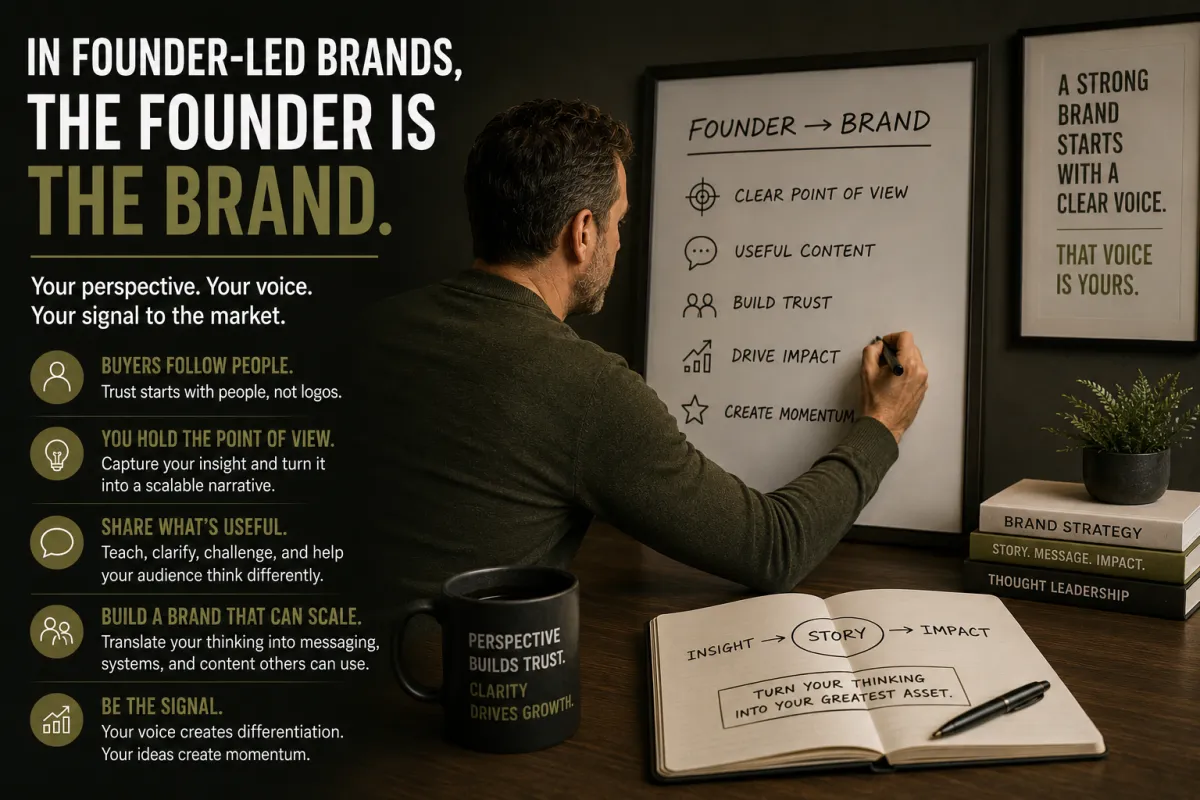
How To Scale Founder-Led Brands, Where the Founder IS the Brand
There’s a certain kind of founder who wants the company to stand on its own. I understand the instinct.
The founder doesn’t want everything to depend on them. They want the brand to feel bigger than one person. They want the business to mature beyond founder-led selling and founder-led explanations. They want systems. They want scale. They want the company taken seriously as an organization, not as an extension of one person’s energy.
All of that is reasonable. But here’s the tension: in many founder-led companies, the founder is still the clearest, strongest, and most credible expression of the brand. Not the logo. Not the tagline. Not the carefully worded About page. The founder. That doesn’t mean the company should be trapped inside the founder’s personality forever. It does mean that if the founder has a clear point of view, deep market insight, and hard-won credibility, that intelligence shouldn’t sit quietly behind the brand. It should help lead it.
The psychology of founder-led growth: people follow people, not logos
In B2B especially, buyers rarely develop trust in the abstract. They may discover you through a search, a referral, a conference, or a post. But at some point they want to understand the people behind the business. Who thinks this way? Who built this? Who do I trust to understand the problem?
A polished brand can create credibility. A visible founder can create connection. That matters because founder-led brands usually sell expertise, judgment, and a different way of seeing the market. People don’t follow logos on LinkedIn the way they follow thoughtful leaders. They follow people who help them understand their own world more clearly. For a founder-led brand, that’s a major advantage.
The founder holds the origin of the point of view
Every strong brand needs a point of view — not just a position in the market, but a perspective about the market. What’s broken? What’s misunderstood? What old assumption needs to be retired? What better way forward does the company believe in?
In founder-led companies, those answers usually already exist in the founder’s head. They show up in sales calls, in offhand comments, in the mild irritation the founder feels about how the category talks about itself, in the reason the company was created at all. But too often that thinking never makes it into the brand. The website becomes safer than the founder. The content becomes more generic than the founder. The public language loses the sharpness that makes the founder compelling in conversation. That’s a missed opportunity. The founder’s job isn’t to become the mascot. It’s to define the strategic intelligence behind the brand.
Visibility is not vanity
A lot of founders hesitate around thought leadership because it can feel self-promotional. They don’t want to become “LinkedIn people.” They don’t want to post for the sake of posting. That hesitation is healthy.
Founder visibility becomes weak when it’s built around ego. It becomes valuable when it’s built around usefulness. The founder doesn’t need to perform. The founder needs to teach, clarify, challenge, and share what they’re learning. A strong founder presence isn’t “look at me.” It’s “here is what I’m seeing in the market, here is where I think the category gets it wrong, here is the problem buyers are struggling to name, and here is a better way to think about it.” That kind of visibility builds trust because it gives value before it asks for attention. And in many cases, how the founder thinks is a direct proxy for how the company operates.
The founder’s voice creates differentiation
A company can have strong services and still sound like everyone else. That’s one of the most common problems in crowded B2B categories. Many companies are competent. Many make similar claims about quality, partnership, and results.
The founder’s voice can break that sameness — not because the founder is inherently fascinating, but because a real human point of view is harder to commoditize than a service description. A founder can name frustrations directly, tell stories from the field, explain why they disagree with conventional wisdom, and put stakes around the problem. When the difference is judgment, philosophy, or the way the company frames the problem, the founder’s voice is often the cleanest way to make that difference visible.
Scaling beyond founder dependency: turning intuition into systems
There’s a real risk on the other side. If everything depends on the founder, the company can’t scale. The founder becomes the best salesperson, the best storyteller, the best strategist, and the only person who can explain the business properly. That works for a while, then becomes a constraint.
The goal isn’t founder dependency. It’s founder intelligence made scalable. Those are different things. Founder dependency means the company needs the founder in the room for the story to work. Founder intelligence made scalable means the company has captured the founder’s insight and turned it into positioning, messaging, narrative, and content the whole team can use. The founder still leads. But the brand no longer loses its clarity the moment the founder steps away.
That’s the real work — not removing the founder from the brand, but translating the founder into the brand. It takes structure: extract the point of view through real conversations, organize it into themes, turn the themes into messaging that can travel beyond the founder’s own mouth, and build a repeatable system so the founder isn’t waking up each morning wondering what to say.
The founder is the signal
One caution. The founder’s visibility should strengthen the company, not compete with it. The right platform sits at the intersection of three things: what the founder genuinely believes, what the market needs to understand, and what the company wants to be known for. When the founder posts there, the trust flows back to the business.
A founder-led company should absolutely build a brand that can scale — clear positioning, a useful website, a repeatable content system, a market presence that doesn’t depend on one person. But pretending the founder isn’t central to that brand is usually a mistake. The founder is often where the belief system lives, where the sharpest insight begins, and the most trusted voice before the company has broad recognition. The job isn’t to hide that. It’s to use it wisely. In founder-led brands, the founder is the signal. Clarified, structured, and amplified, that signal becomes one of the most powerful assets the brand has.
--
About Stone Soup Strategy Stone Soup Strategy helps companies clarify their story, sharpen their message, and build marketing systems that support intentional growth. We partner with growth-minded organizations through focused Productized Sprints, ongoing Fractional Marketing Leadership, and flexible Custom Consulting tailored to your specific strategic needs. Find the right starting point for your brand at www.stonesoupstrategy.marketing.
