
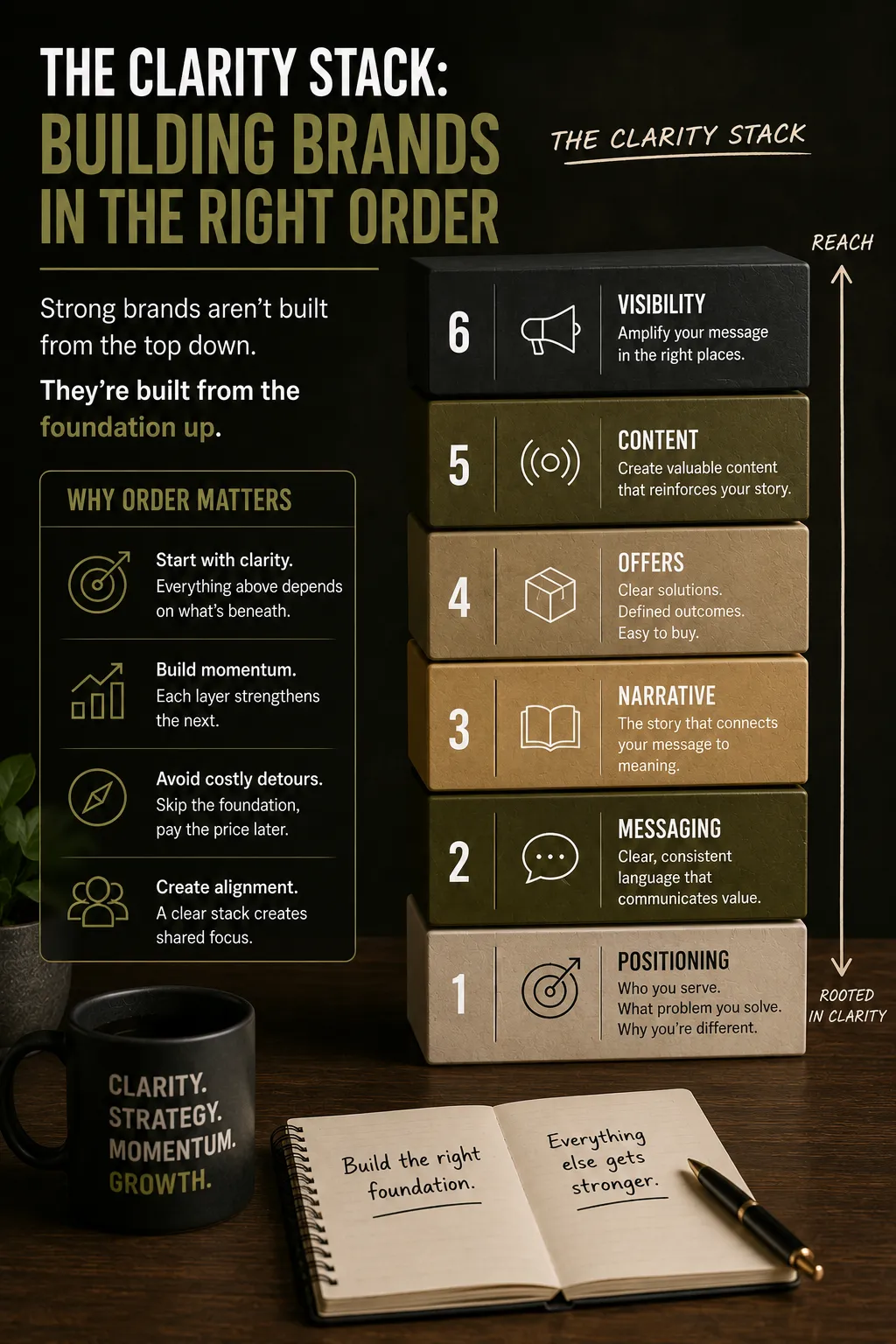
The B2B Brand Building Framework: The 6-Layer Clarity Stack
There’s a right order to building a brand. That doesn’t mean most companies follow it.
Most start somewhere in the middle, or near the top, because that’s where the visible work lives. They start with the website, the campaign, the content calendar, the new logo, the refreshed homepage. Those things matter. But they aren’t the foundation. They’re the parts of the brand people can see — and because people can see them, they feel like progress.
Foundational work is different. It’s quieter. It asks harder questions, forcing decisions about identity, audience, value, and story before the team gets to the satisfying work of making things. That can feel inefficient. But skipping the foundation is what creates the real inefficiency, because every downstream effort then has to compensate for the missing layer beneath it. That’s why I think of brand building as a stack. Each layer supports the next, and if the lower layers are weak, everything above them has to work harder.
Marketing inefficiency: the danger of starting at the top
A company decides it needs more visibility, so it starts posting. The posts feel scattered, so it builds a content calendar. The calendar lacks a point of view, so it tries to define themes. The themes don’t connect to a clear position, so it revisits messaging. The messaging is hard to write because the positioning isn’t clear. Eventually the company ends up back at the questions it should have answered first: who are we, who are we for, what problem do we solve, and what do we want the market to remember?
This backward path is common, and it’s expensive — not always in money, but in time, energy, and lost momentum. The team keeps working, but the work doesn’t compound. That’s the sign the stack is out of order.
Layer one: Brand positioning strategy
Positioning is the bottom of the stack. It answers the most basic strategic questions: where do we sit, who do we serve, what problem do we solve, and why are we the right company to solve it? Positioning isn’t the tagline or the homepage headline. Those are expressions of positioning. The positioning itself is the strategic decision, and every other layer depends on it. It also requires choices. A company can’t be equally focused on every audience, problem, and use case. The question isn’t “what could we say?” but “what should we be known for?”
Layer two: Strategic B2B messaging
Once positioning is clear, messaging turns strategy into language — the words, themes, claims, and proof points that help the market understand the position. Good messaging doesn’t just make the company sound better; it makes the company easier to understand. A lot of messaging work gets treated as copy polish, and there’s value in sharper phrasing — but only if the underlying message is right. Messaging should create shared language across the business: sales uses it, the website reflects it, the founder speaks from it, the content reinforces it. When it’s strong, the company stops re-explaining itself from scratch every time it communicates. That’s a major step toward scale.
Layer three: The corporate brand narrative
Messaging explains. Narrative connects. This is where the brand moves beyond “what we do” and starts making meaning. A strong narrative gives the company a through-line: what has changed, what problem the audience faces, what insight you bring, how you approach it, and what transformation you create. Without narrative, even clear messaging can feel flat — accurate but not memorable, professional but not differentiated. Narrative gives the brand movement. It’s especially important in founder-led companies, consultancies, and emerging categories, where buyers aren’t just comparing features. They’re evaluating judgment, trust, and fit.
Layer four: Packaging your offers
With positioning, messaging, and narrative in place, the company can define its offers. This is where many businesses get tangled. They know what they do but haven’t packaged it in a way the market can grasp, so the buyer has to work too hard to know where to begin. Strong offers create entry points. They help the buyer say, “That sounds like what we need.” An offer isn’t just a list of deliverables. It’s a structured promise: what this solves, who it’s for, what outcome it creates, and why the approach makes sense. For a consultancy or fractional practice especially, sharper packaging is often what turns broad capability into something buyers can confidently engage.
Layer five: Point-of-view content engine
Content sits above the strategic foundation, and it shouldn’t be asked to create that foundation by itself. This is where a lot of companies get into trouble — they produce content before they know what story it’s supposed to reinforce, and the result is activity without accumulation. Each piece should do at least one job: clarify the problem, teach the market how to think about it, make the point of view visible, support the offers, build trust in the founder or team, or reinforce what the brand wants to be known for. Content isn’t just output. It’s the repeated expression of the brand’s strategic center.
Layer six: Market visibility & distribution
Visibility is the top of the stack — distribution, PR, social, events, campaigns, search. It matters, but it’s dangerous when it comes too early. If the brand is unclear, visibility just spreads the confusion — getting more people to see an unclear message doesn’t solve the problem, it reveals it faster. Visibility works best when there’s something clear, useful, and memorable to amplify. When the lower layers are strong, the market starts hearing consistent ideas from multiple places at once, and visibility creates momentum instead of noise.
Build from the bottom up
The Clarity Stack is simple: positioning, messaging, narrative, offers, content, visibility. Each layer depends on the one beneath it. Positioning gives messaging direction. Messaging gives narrative language. Narrative gives offers meaning. Offers give content focus. Content gives visibility substance.
This doesn’t mean freezing until every layer is perfect. Brands are living systems; messaging sharpens through use, content reveals what resonates. The point is to build with awareness of the sequence. If your content isn’t working, look beneath it. If your website is hard to write, or your founder is still the only one who can explain the company, look beneath that too. The problem is usually lower in the stack than it first appears.
Brands don’t scale because they’re busy. They scale because the market understands them, remembers them, and knows why they matter. That kind of strength is built in layers. Build in the right order, and every layer makes the next one stronger. Most companies don’t need more disconnected marketing activity. They need a stronger stack.
--
About Stone Soup Strategy Stone Soup Strategy helps companies clarify their story, sharpen their message, and build marketing systems that support intentional growth. We partner with growth-minded organizations through focused Productized Sprints, ongoing Fractional Marketing Leadership, and flexible Custom Consulting tailored to your specific strategic needs. Find the right starting point for your brand at www.stonesoupstrategy.marketing.
