
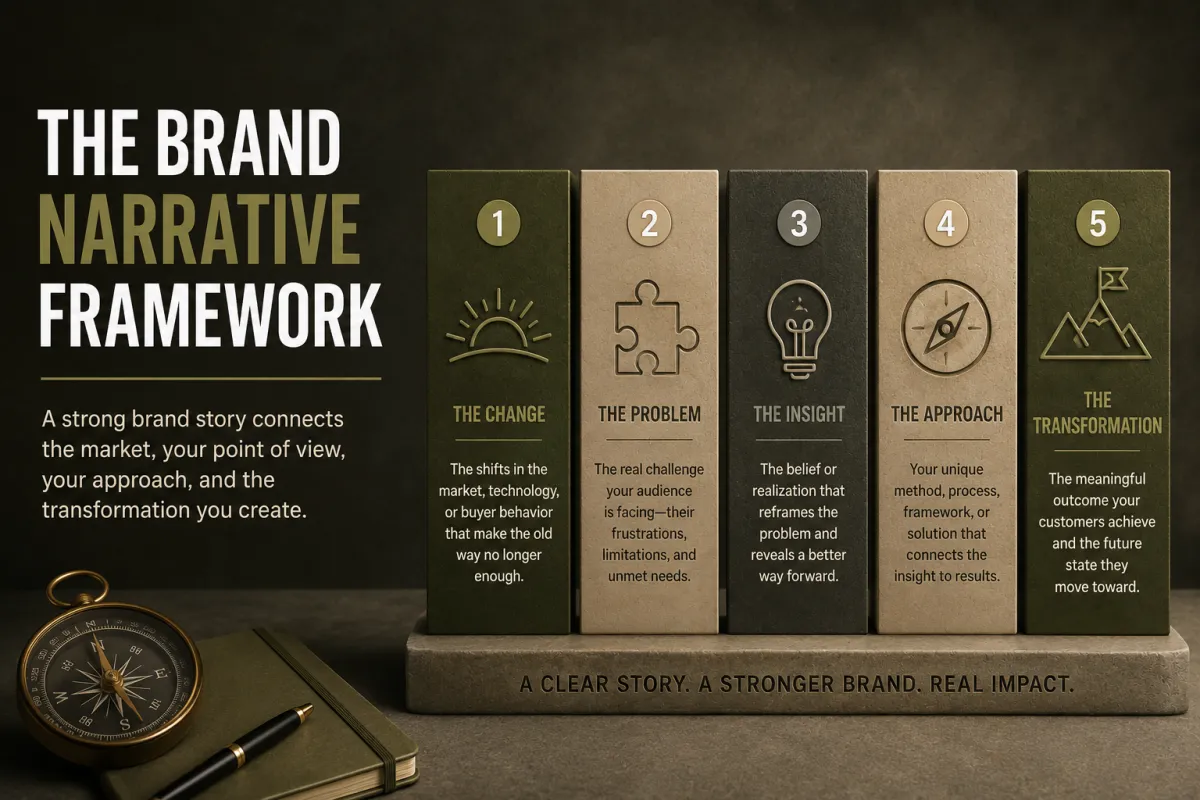
The B2B Brand Narrative Framework: A 5-Part Blueprint
Most brand stories fail because they answer the wrong question. They explain what the company does. That’s useful, but it isn’t enough.
A strong brand story has to do more than describe the business. It has to help the right audience understand why the business matters, why the problem is worth caring about, and why this company has a meaningful way of solving it.
This is where many companies lose the thread. They confuse narrative with background — the founding date, the service list, a tidy paragraph that could sit on the About page of every other company in the category. An origin story is fine and a description of capabilities is fine, but neither one automatically creates a narrative. A real brand narrative gives the company a backbone that connects the market problem, the buyer’s reality, the company’s point of view, the solution, and the future state the customer is trying to reach. People don’t remember disconnected information; they remember stories that help them make sense of something.
Why a great brand narrative begins in the buyer's world
The first mistake is assuming the brand story begins with the company. It rarely does. Your company may be the hero of your internal story, but it isn’t the hero of the market’s story. The buyer is — the one dealing with the problem, managing internal pressure, weighing tradeoffs, and deciding whether you’re worth their time and trust.
So a useful narrative begins in the buyer’s world, not yours. What are they struggling to understand? What has changed in their environment? What old way of working is no longer enough? Start there and you stop saying “here is our company and everything it does,” and start saying “here is the problem you’re facing, why it matters, and a better way forward.” That shift changes everything.
The 5-part brand narrative frameowork
A strong narrative doesn’t have to be complicated. The simpler it is, the more useful it becomes. The framework I use has five parts: the Change, the Problem, the Insight, the Approach, and the Transformation. Each has a job. Together they create a story that can support a website, a sales deck, a founder’s platform, and a content strategy.
1. The Change
Every strong narrative begins with change — a shift in the market, the category, the technology, or the buyer’s world that makes the story timely. Without change, there’s no urgency. The change might be external and obvious: AI is reshaping how teams work; buyer behavior has shifted; budgets are under scrutiny. Or it might be quieter and internal: the company has outgrown its original story; the founder can no longer personally explain the value to every buyer. Either way, the job is to frame the world the buyer now lives in. A company that skips this step sounds like it’s solving a problem in a vacuum.
2. The Problem
Once the change is clear, the narrative has to name the problem — not the surface symptom, the real one. This is where companies stay too shallow. “We need a better website.” “We need more leads.” Those may be true, but the deeper problem might be that the company can’t articulate its value in a way the market understands, or that sales depends too heavily on founder explanation. A good problem statement creates the reaction: “Yes. That’s exactly what is happening.” It doesn’t say “marketing is hard.” It says “your marketing is working too hard because the positioning underneath it is unclear.” That’s a different level of diagnosis, and it builds trust before you describe a solution.
3. The Insight
The insight is the heart of the narrative. It’s the belief that reframes the problem, and it’s where the brand earns a point of view. A weak story jumps from problem to solution: “You have this issue, we offer this service.” Clear, but not memorable. The insight explains what you understand that the market may be missing. For Stone Soup, one central insight is that many companies don’t have a marketing problem first — they have a clarity problem. They’re trying to scale visibility before building the positioning, messaging, and systems that let marketing compound. That insight reframes the buyer’s frustration, explains why earlier efforts fell flat, and gives a reason to approach the problem differently. Every strong brand needs that kind of interpretive center.
4. The Approach
Only after the change, problem, and insight are clear should you introduce your approach. Lead with process too early and it feels like a list of services. Lead with the narrative first and the process becomes the natural response to the problem. The approach answers: how do you solve this differently or more effectively than the alternatives? This is where frameworks, methods, and experience belong — but always connected back to the story. If the problem is unclear positioning, the approach begins with foundational strategy. The approach shouldn’t feel bolted on. It should feel inevitable.
5. The Transformation
The final part is the transformation — not a generic promise like “grow faster,” but the specific before-and-after your brand exists to create: from confusion to clarity, from scattered activity to intentional systems, from a company that keeps explaining itself to one the market understands faster. This shifts the conversation from deliverables to outcomes. A buyer may think they want a website; what they really want is a website that finally explains the company well enough to support growth. The transformation is where the story becomes valuable.
The story is already there
In most companies, the narrative doesn’t have to be invented from scratch. It already exists in pieces — in the founder’s frustration with the category, in the sales calls where a prospect finally says “that’s exactly what we need,” in the customer stories that reveal the real value, in the gap between what the company does and what the website says.
The work is to find the thread, then strengthen it, structure it, and make it usable. A good narrative doesn’t make the company sound like something it’s not. It makes the company easier to understand as what it already is. And it should show up everywhere — the homepage, the deck, the founder’s posts, the case studies — expressed differently by format but consistent in logic. That consistency is what creates memory. Because a brand story should never just answer “what do we do?” It should answer the more important question: why does this matter, and why now?
--
About Stone Soup Strategy Stone Soup Strategy helps companies clarify their story, sharpen their message, and build marketing systems that support intentional growth. We partner with growth-minded organizations through focused Productized Sprints, ongoing Fractional Marketing Leadership, and flexible Custom Consulting tailored to your specific strategic needs. Find the right starting point for your brand at www.stonesoupstrategy.marketing.
