
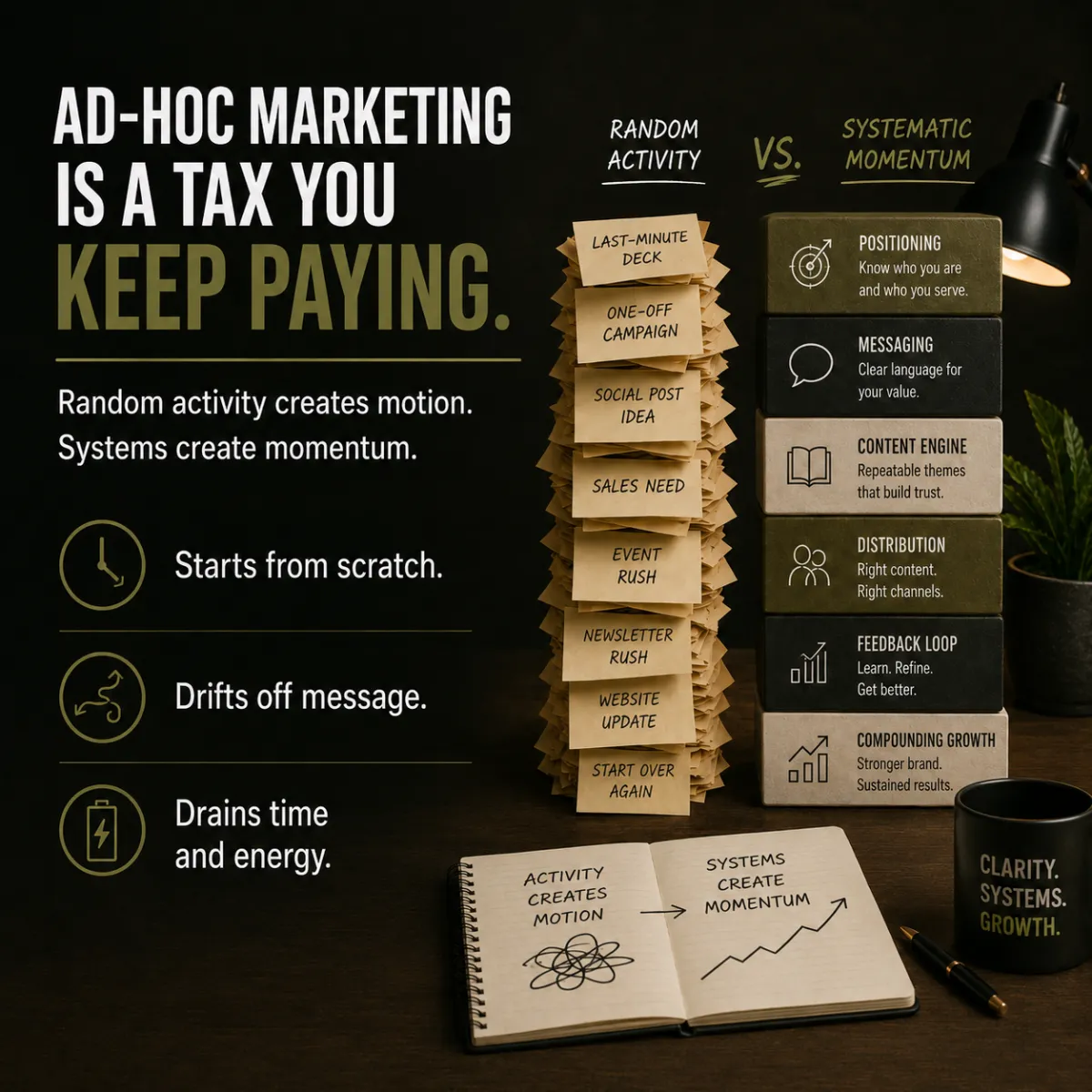
Ad-Hoc Marketing vs. Systems: top Paying The Hidden Tax
There’s a kind of marketing that feels productive while it’s happening.
A post goes up. A one-sheet gets made. A newsletter gets pulled together. A deck gets revised. A conference is coming, so the team rushes to prepare something. A prospect asks for a use case, so someone builds a new slide. Individually, none of this is wrong. Some of it may be quite good. The article may be thoughtful. The deck may help close a deal.
But if every piece of marketing is created as a one-off, the company is paying a hidden tax. Not only in dollars, though the dollars are real. It pays in time, in inconsistency, in duplicated effort, in founder attention, and in the quiet exhaustion of constantly reinventing the wheel. Ad-hoc marketing creates activity. Systems create momentum. That difference matters more than most companies realize.
The problem with ad-hoc marketing: "what do we do next?"
A lot of marketing starts with the wrong question: “What should we do next?” It sounds practical. It gets people moving. But asked without a system behind it, the answer usually depends on whatever is loudest that week — a sales need, a founder idea, a competitor post, a looming event, a vague sense that the company should be “more visible.”
The result is marketing by urgency. The team keeps producing, but the work doesn’t connect. The content doesn’t build. The messaging shifts slightly from piece to piece. Every asset requires a fresh debate about what to say, who it’s for, and how it should sound. That’s exhausting, and it makes it very hard for marketing to compound — because compounding requires repetition, consistency, and a clear center. Ad-hoc marketing moves, but not always in a direction.
Systems do not kill creativity
One reason people resist marketing systems is the worry that systems make the work rigid. I understand the concern. Bad systems do exactly that — a content calendar becomes a checklist, templates go stale, structure turns into formula.
But good systems don’t kill creativity. They protect it. A good system removes unnecessary reinvention so the creative energy can go where it actually matters. You shouldn’t have to rediscover your audience every time you write a post. You shouldn’t have to re-argue your positioning every time you build a deck. You shouldn’t have to invent your brand voice from scratch every time you send an email. Structure creates freedom. It gives the team a shared foundation so people can move faster and spend their energy sharpening the idea instead of rebuilding the frame.
What a marketing system actually looks like
A marketing system doesn’t need to be complicated. The best ones are simple enough to use consistently. At the foundation is positioning: who you are, who you serve, what problem you solve, why your approach is different. Next is messaging: core language, supporting pillars, proof points, a clear way to explain value. Then narrative: the larger story of what has changed, what the buyer faces, what insight you bring, and what transformation you create. Then the content engine: repeatable themes, post formats, founder POVs, and customer stories that all ladder back to the same foundation. Then distribution: knowing where your ideas should live. Then feedback: learning what resonates, what sales uses, what prospects ask about.
That’s a system. Not a giant machine. Not a ninety-page plan. A repeatable way to turn clarity into market presence.
The founder should not be the system
In many founder-led companies, the founder is the marketing system. The founder knows the story, writes the best post, fixes the deck, tells sales what to say. This works for a while, because the founder’s intuition is usually good. But it doesn’t scale.
If every meaningful marketing decision depends on the founder’s personal involvement, the company doesn’t have a system. It has a founder-powered workaround. And that creates a predictable pattern: the founder becomes the bottleneck, the team waits for direction, marketing happens in bursts, and the messaging drifts whenever the founder gets pulled elsewhere.
The answer isn’t to remove the founder. The founder’s intelligence is often the company’s strongest asset. The answer is to capture that intelligence and turn it into structure — turn the thinking into positioning, the positioning into messaging, the messaging into content themes, and the themes into a repeatable editorial system. That’s how founder insight becomes company capability.
The hidden cost of starting from scratch
The biggest cost of ad-hoc marketing isn’t always in the budget. It’s in the time spent starting from scratch. A new deck starts from a blank file. A new article starts from a blank page. A new campaign starts from a blank strategy conversation. A new sales asset starts with someone asking, “Do we have language for this?”
Every blank start is a tax. A system reduces the number of blank starts. It gives you reusable parts: message pillars, audience language, proof points, article themes, case study structures, sales narratives, and strategic filters. The work still has to be thoughtful and tailored and good. But it no longer has to be invented from nothing every time. That’s where efficiency and quality begin to reinforce each other.
Stop paying the tax
There will always be one-off needs. A business is alive. Opportunities appear, priorities shift, sales needs help, the market changes. A good marketing operation has to be flexible enough to respond. A system actually makes that response better — when something timely happens, the system helps you respond through the lens of your point of view, and gives every good idea somewhere to go.
But if everything is a one-off, the company isn’t building leverage. It’s paying the ad-hoc tax over and over. The goal isn’t to eliminate spontaneity. It’s to stop mistaking spontaneity for strategy. The companies that grow consistently aren’t always the ones producing the most. They’re the ones building from the clearest system. They know what they believe, what they want to be known for, and how to turn that clarity into content, campaigns, and conversations — repeating the right ideas without making the brand feel repetitive. Ad-hoc marketing creates temporary motion. Systems create momentum. And momentum is what growth actually needs.
--
About Stone Soup Strategy
Stone Soup Strategy helps companies clarify their story, sharpen their message, and build marketing systems that support intentional growth. We partner with growth-minded organizations through focused Productized Sprints, ongoing Fractional Marketing Leadership, and flexible Custom Consulting tailored to your specific strategic needs. Find the right starting point for your brand at www.stonesoupstrategy.marketing.
