
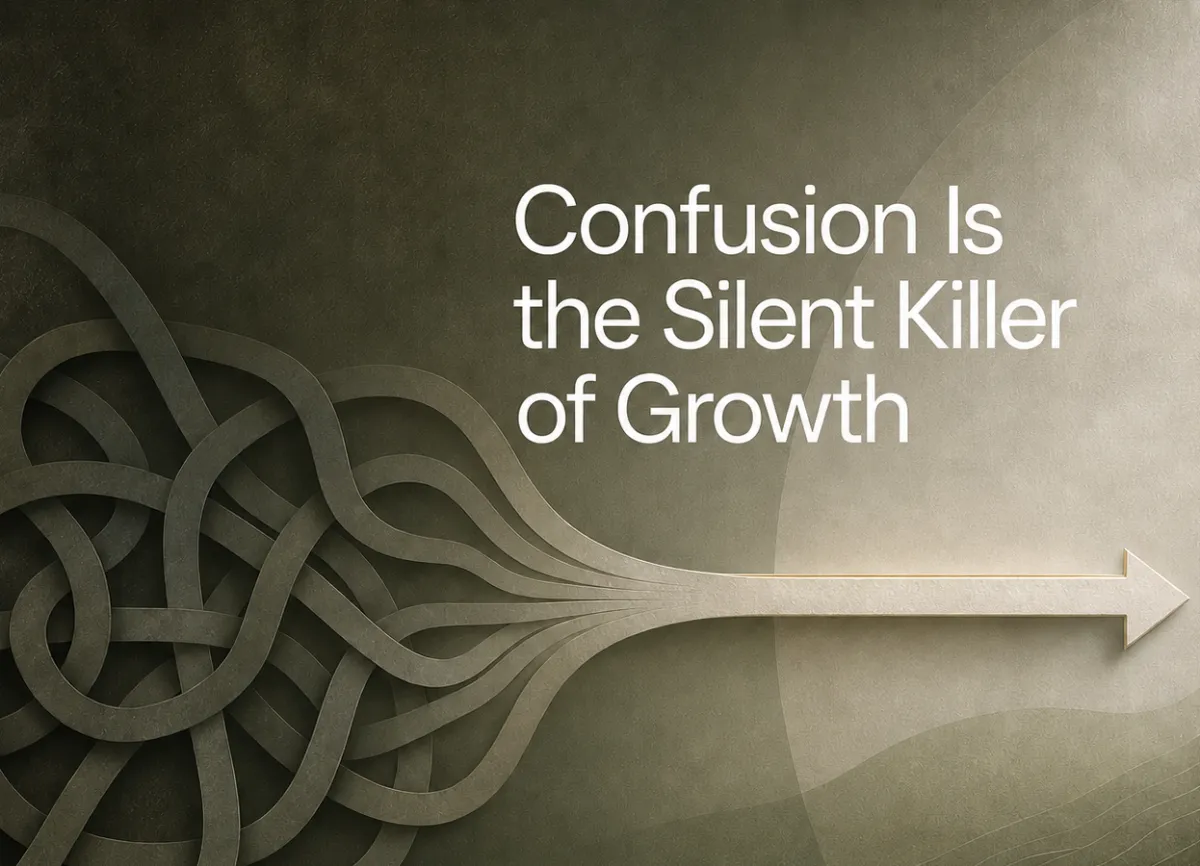
Confusion Is the Silent Killer of Growth
You can’t scale what you can’t articulate.
I’ve seen this pattern many times.
A founder builds something genuinely valuable. The product works. The service solves a real problem. Early customers understand the value because they get the benefit of a conversation, a demo, a referral, or a long explanation from the person who created it.
Then the company reaches the point where it wants to grow.
That is when everything gets harder.
The website needs to explain the business clearly. The sales team needs a sharper pitch. The founder needs to show up more consistently. The company needs content, campaigns, case studies, sales collateral, maybe a new deck, maybe a new website.
So everyone starts moving. They revise the homepage. They hire a designer. They experiment with content. They run campaigns. They try to “get the word out.”
But the problem is not always visibility.
Sometimes the problem is that the word is not clear enough to get out.
The Growth Problem That Looks Like a Marketing Problem
Inside a company, people often believe the brand is clearer than it is.
That makes sense. The team lives inside the business every day. They know the customer stories, the product details, the pivots, the hard-won insights, and the conversations that shaped the offering.
But the market does not live inside your company.
A prospect lands on your website and gives you a few moments to make sense. A partner scans your LinkedIn page. A buyer hears your company mentioned and tries to place you in a category.
When the story is unclear, people do not usually stop and work harder to understand it.
They move on.
That is the danger of confusion. It rarely announces itself dramatically. It shows up as drag.
The sales cycle takes longer. Referrals are harder to explain. Content feels scattered. The website sounds accurate but not compelling. The founder keeps re-explaining the business in slightly different ways. The team nods along internally, but no one is quite using the same language.
Growth slows, not because the company lacks value, but because the value is too difficult to grasp.
Clarity Is Not a Tagline
When people hear “brand clarity,” they sometimes think it means a sharper tagline or a cleaner elevator pitch.
Those things can help, but they are outputs. They are not the foundation.
Real clarity answers more fundamental questions.
What category are we in? Who do we serve? What problem do we solve? Why does that problem matter now? What makes our approach different? Why should someone trust us? What should people remember?
Until those answers are clear, most marketing activity becomes harder than it needs to be.
A website project becomes a copywriting debate. A content strategy becomes a list of topics. A sales deck becomes a pile of features. A campaign becomes a clever idea in search of a message.
The company may be busy, but the market still may not understand why it matters.
The Founder Usually Knows More Than the Brand Says
One of the most interesting things about founder-led companies is that the clarity often exists somewhere. It just has not been extracted, structured, and turned into language.
The founder can usually explain the business beautifully in conversation. Not always briefly, but beautifully.
They can tell you why they started it, what frustrates them about the category, what customers misunderstand, where the opportunity is, and why their approach is different.
But that intelligence often stays trapped in conversations.
It does not fully make its way into the website, the messaging architecture, the content strategy, or the repeatable story the rest of the company can use.
In many founder-led companies, the founder’s understanding of the market is one of the brand’s greatest strategic assets. The work is not to invent something artificial. The work is to listen carefully, find the signal, and build a structure around it.
Good positioning often feels less like creation and more like excavation.
The truth is already there. It just needs to be made usable.
Why Confusion Gets Worse as You Grow
In the early days, confusion is manageable because the founder can compensate for it.
A prospect has a question? The founder explains. The website is vague? A warm referral fills in the blanks. The sales process is inconsistent? The founder jumps on the call. The pitch is too long? It still works because the person delivering it has conviction.
But scale exposes every weak point in the story.
More people start communicating on behalf of the company. Sales, marketing, customer success, recruiting, partnerships, investors, and advisors all need language. They need a shared understanding of what the company does and why it matters.
If that shared understanding does not exist, the brand begins to fragment.
Everyone says something slightly different. Not wildly different. Just different enough to create noise.
And noise is expensive.
It costs time in sales conversations. It costs confidence in marketing decisions. It costs consistency across content. It costs trust with buyers who are trying to understand whether you are the right fit.
The irony is that many companies respond to this by doing more.
More campaigns. More content. More design. More meetings. More revisions.
But more activity does not solve unclear strategy. It usually amplifies it.
Clarity Creates Momentum
The best marketing does not begin with a campaign. It begins with alignment.
When a company can clearly articulate who it is, who it serves, what problem it solves, and why its approach matters, everything downstream gets easier.
The website gets sharper. The sales deck gets simpler. The content gets more focused. The founder’s voice gets stronger. The team starts using the same language. The market starts understanding the company faster.
That is when marketing begins to compound. Not because every piece of content is brilliant or every campaign is perfect, but because everything is finally pointing in the same direction.
Clarity is not a cosmetic exercise. It is not “wordsmithing.” It is not a branding luxury companies get to after the serious business work is done.
Clarity is business infrastructure.
It is how the company explains itself to the market, aligns its team, earns trust, and creates the conditions for growth.
You can have a remarkable product, a committed team, and a real market opportunity. But if no one can explain what you do in a way that lands quickly and clearly, growth will always be harder than it needs to be.
Confusion is the silent killer of growth.
Clarity is how you start fighting back.
David Shay
Founder - Stone Soup Strategy
