
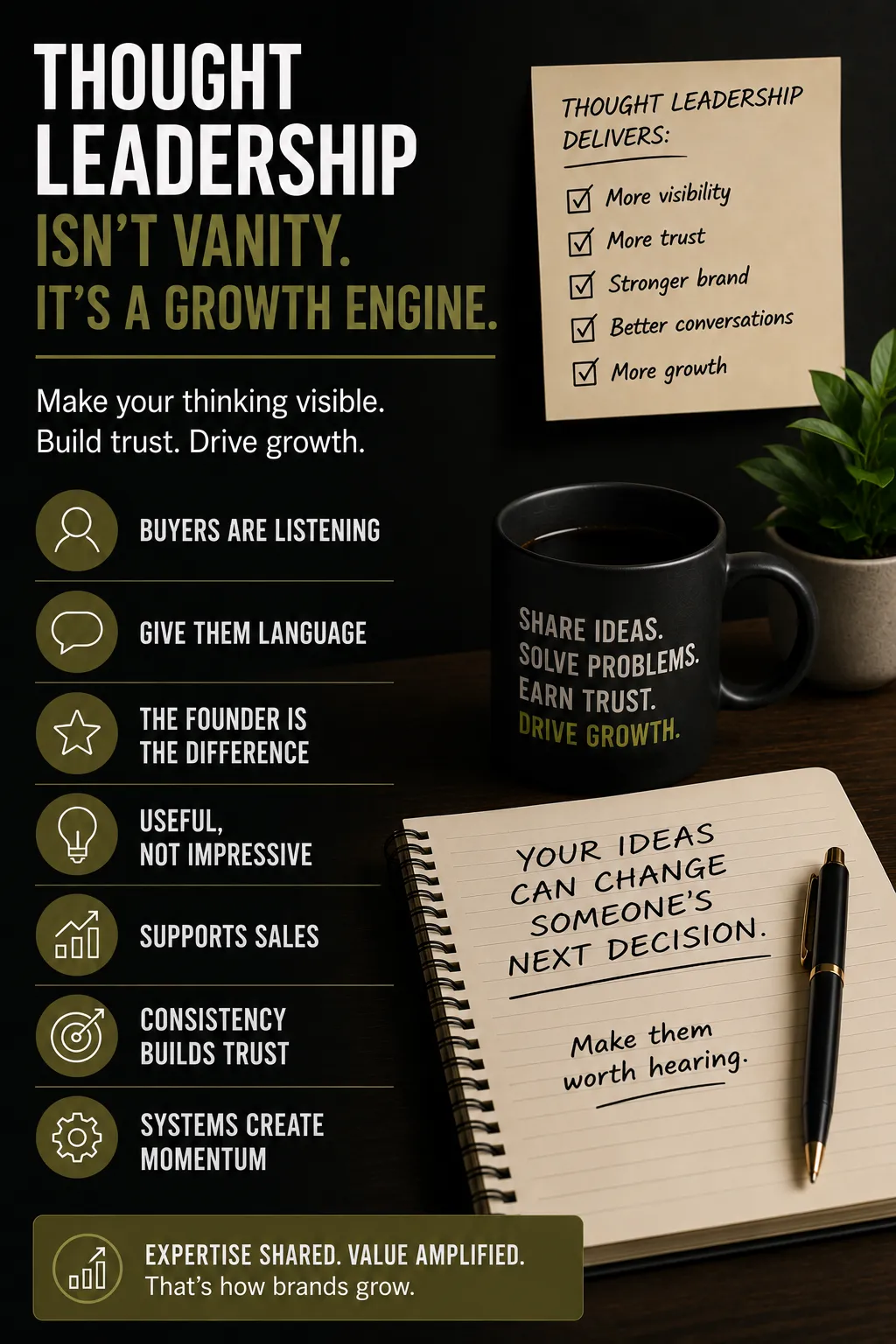
B2B Thought Learship Strategy: A Growth Engine Not Vanity
A lot of founders understand thought leadership in theory. They know they should be more visible, that buyers spend time on LinkedIn, that if the company has a point of view the market should probably hear it.
Then the hesitation starts. “I don’t want to sound self-promotional.” “I don’t have time to post constantly.” “Is anyone really going to care what I think?”
I understand all of that. There’s a version of thought leadership that deserves every bit of skepticism it gets — the performative kind, the humblebrag kind, the “five leadership lessons I learned from ordering coffee” kind. That’s not what I mean. Real thought leadership isn’t vanity. It’s the disciplined practice of making your expertise useful, visible, and repeatable. And for many founder-led B2B companies, it may be one of the highest-leverage growth activities available.
The modern B2B buyer: researching your thought leadership before the call
The modern B2B buyer does a lot of quiet research before ever getting on a call. They visit the website, read the founder’s posts, and check whether there’s a real point of view or just a title. They want to understand not only what you sell, but how the people behind it think.
That last part matters. In categories where trust, judgment, and fit are important, buyers aren’t only evaluating the offer — they’re evaluating the thinking behind it. Do these people understand the problem? Do they see the market clearly? Thought leadership answers those questions before the sales process begins. It creates credibility before the pitch. That’s not soft marketing. It’s demand generation with a longer runway.
It gives the market language
One of the most valuable things thought leadership can do is give people language for a problem they’re already feeling. A buyer isn’t sitting around thinking, “We need a brand positioning and narrative engagement.” But they may be thinking, “Our website looks fine, but it still doesn’t explain us,” or “Our content is active, but it feels scattered.”
When thought leadership names those experiences clearly, the buyer feels understood — which can be more powerful than a direct pitch, because you’re no longer just offering a service, you’re helping the buyer make sense of what they’re experiencing. That’s why useful thought leadership often begins with diagnosis — not “here is what we do,” but “here is the problem you may be living with, here is why it matters, and here is a better way to think about it.”
Why a brand point of view beats a content posting schedule
A lot of companies treat thought leadership as a cadence problem: how often should we post, which days, twice a week or five times? These are practical questions, but they aren’t the starting point. The starting point is point of view. What do you believe that’s useful to your market? What problem do you see more clearly than others? What assumptions in your category deserve to be challenged?
Without a point of view, thought leadership becomes content production. With one, it becomes a platform that can support articles, posts, webinars, talks, sales conversations, and website copy. The cadence matters eventually. But the point of view is what makes the cadence worth following.
The founder is usually the best asset
In founder-led companies, the founder holds the raw material — not because the founder must be the face of everything forever, but because the founder usually has the clearest view of why the company exists and what the market needs to understand. That thinking is an asset, but it’s often trapped in calls, meetings, and offhand comments. Thought leadership turns it into leverage, taking what the founder already explains one-to-one and turning it into something the market can encounter one-to-many. That doesn’t require becoming a full-time content creator. The founder doesn’t need to post constantly. The founder needs to be useful consistently.
Useful beats impressive
Some founders avoid thought leadership because they think every post has to be profound. It doesn’t — trying to sound profound is one of the fastest ways to become unreadable. The best thought leadership is clear, specific, and grounded. It might explain a mistake companies make before redesigning a website, or name the difference between positioning and marketing, or describe a pattern you keep seeing in sales conversations. None of that requires theatrics. It requires attention — noticing what your audience is struggling to articulate, then helping them articulate it. That’s an act of service, and service builds trust.
Using executive content for B2B sales enablement
Thought leadership creates sales value without making everything sound like a sales message. A strong article can warm up a prospect before outreach; a framework can become part of a sales conversation; a recurring theme can help referrals explain what you do. This is especially valuable when the sales cycle depends on trust. Instead of saying “we think clarity matters,” you can point to an article that explains exactly why confusion stalls growth. The content becomes proof of thinking — and in many B2B categories, thinking is part of what the buyer is buying.
Consistency builds market memory
One article won’t transform a brand. Thought leadership works through accumulation: the market needs repeated exposure to your ideas before it associates you with a problem or a point of view. That’s market memory. So when someone in your network hears about a company struggling with unclear positioning or founder-dependent storytelling, they think of you — not because you posted once, but because your ideas became recognizable. It works best with a system behind it, structured enough to reinforce the brand while staying human enough to sound like the founder actually thinks this way.
The goal is trust, not visibility
The goal of thought leadership isn’t simply to be seen. You can be visible and forgettable, visible and vague, visible and disconnected from the business you’re trying to build. The goal is trust — that you understand the buyer’s world, that your company has a real point of view, that engaging with you would make the buyer smarter, not just more marketed to.
Most founder-led companies have more insight than the market can see. The company has a point of view, even if it hasn’t been fully articulated yet. Thought leadership brings that intelligence to the surface — not all at once, not as noise, but as a steady, useful signal. It teaches the market how to think about the problem, builds credibility before the sales conversation, and turns founder expertise into brand equity. That’s why it isn’t vanity. At its best, it’s a growth engine. Not because it shouts. Because it clarifies.
--
About Stone Soup Strategy Stone Soup Strategy helps companies clarify their story, sharpen their message, and build marketing systems that support intentional growth. We partner with growth-minded organizations through focused Productized Sprints, ongoing Fractional Marketing Leadership, and flexible Custom Consulting tailored to your specific strategic needs. Find the right starting point for your brand at www.stonesoupstrategy.marketing.
