
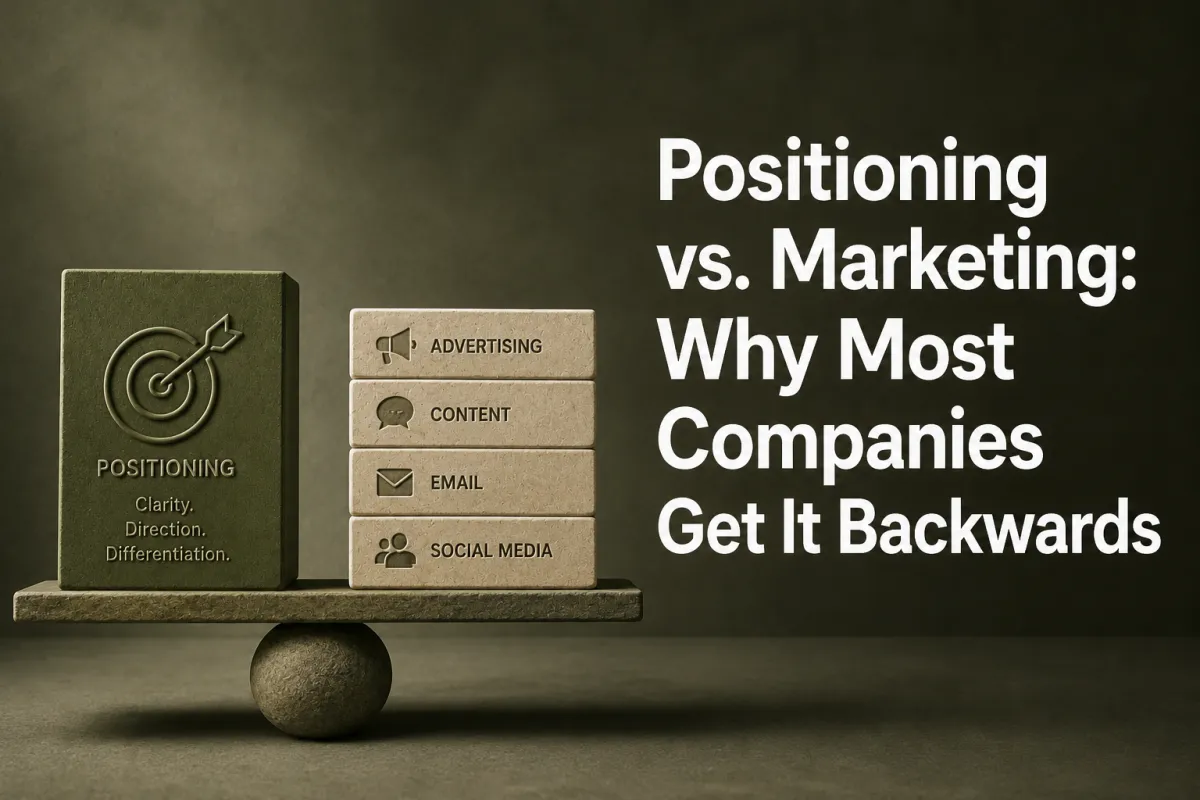
Positioning vs. Marketing: Why Most Companies Get It Backwards
Most companies start with marketing.
They launch campaigns. They redesign the website. They post more on LinkedIn. They build decks, email sequences, and landing pages. Then a few months later they look around and wonder why it all feels harder than it should.
The content isn’t landing. The new website looks better but doesn’t convert. The deck is still too complicated. The campaigns create activity but not momentum. And the founder is still jumping on calls to explain what the company actually does.
When that happens, the instinct is to fix the marketing. Sharpen the copy. Modernize the design. Find better topics. Maybe the agency just didn’t get it. Sometimes that’s true. But more often, the real problem sits one layer deeper. The company started marketing before it had clear positioning. And when that happens, even good marketing has to work too hard.
Marketing is the expression. Positioning is the foundation.
Marketing is how you bring your story into the market. Positioning is the decision about what that story should be.
Marketing is the visible part: the website, the content, the campaigns, the ads, the sales enablement. Positioning is the underlying logic that tells those things what to say. It defines where you sit, who you’re built for, what problem you solve, why that problem matters, and what you want the buyer to remember.
Without positioning, marketing becomes improvisation. Sometimes the improvisation is clever. Sometimes it even wins in the short term. But it isn’t a system. It’s a series of disconnected attempts to create attention without a stable center. That’s why a company can spend real money on marketing and still feel like nothing is compounding. It’s producing outputs before resolving the meaning behind them.
The sequence matters
The right order isn’t complicated. Positioning first. Messaging second. Marketing third.
Positioning answers: where do we fit, and why do we matter? Messaging answers: how do we say that clearly and consistently? Marketing answers: where, when, and how do we get it in front of the market?
Reverse that order and the symptoms show up fast. A website project stalls because no one agrees on the core message. A campaign gets watered down because the audience is too broad. Content sounds generic because the point of view was never defined. The sales deck bloats because the company is trying to explain everything instead of leading with what matters most.
That’s not a creative problem. It’s a sequencing problem. You can’t write your way out of unclear positioning, and you can’t design your way out either. You can make the confusion more attractive, but the market will still feel it.
Why companies skip it
Most companies don’t skip positioning because they’re careless. They skip it because marketing feels more urgent. The website needs to launch. Sales needs better materials. The board wants pipeline. There’s a conference coming up. Positioning, by comparison, can feel like a pause — it asks foundational questions at exactly the moment everyone wants action.
Who are we really for? What category are we claiming? What do we want to be known for? What should we stop saying because it’s diluting the story? Those questions create decisions, and decisions can be uncomfortable because they close doors. If you choose one primary audience, you’re not treating every audience as equal. If you lead with one core problem, you’re not leading with every possible use case. That discomfort is exactly the point. Positioning forces the strategic choices marketing needs in order to work.
Good positioning makes marketing easier
There’s a misconception that positioning is theoretical. It’s the opposite. It’s intensely practical, because it reduces waste everywhere downstream.
When positioning is clear, the homepage gets easier to write because the hierarchy is obvious. The content calendar gets easier to build because you know which conversations you should own. The deck gets tighter because the story has a sequence. The founder’s thought leadership gets sharper because it’s anchored in a defined point of view.
Good positioning gives marketing a filter. Should we write about this? Does this campaign reinforce what we want to be known for? Is this aimed at our real buyer? Are we explaining features, or framing the problem in a way that creates urgency? Without that filter, marketing becomes a volume game — more posts, more assets, more activity. With it, marketing becomes intentional.
Positioning is not a one-time workshop
There’s a trap here. Companies treat positioning as a branding exercise that happens once, gets documented, and disappears into a folder. That’s not enough. Positioning should become an operating tool. It should show up in the first sentence of the website, in the structure of the deck, in the founder’s posts, in the questions sales asks, in the themes that guide the content engine. The positioning itself doesn’t need to change every month — in fact it shouldn’t. But it does need to be used.
In founder-led companies, the position usually exists in fragments before it exists formally. The founder knows why the company matters but explains it differently to every audience. The instinct is ahead of the articulation. The work is to close that gap — to turn instinct into language, and language into a system the team can repeat. The best positioning tends to feel obvious once it’s said. Not because it was easy to find, but because it finally gives shape to something the company already knew.
Build the foundation before the machine
The companies that grow with the most confidence aren’t always the loudest. They’re usually the ones with the clearest strategic center. They know who they are, who they’re for, what problem they own, and what they want the market to remember. That clarity gives their marketing force — not because every sentence is perfect, but because every message connects to the same foundation.
So before the next website, campaign, or agency brief, pause long enough to ask whether the positioning is actually clear. Not internally familiar. Not vaguely agreed upon. Clear. Because marketing can amplify a strong position. It can express it, distribute it, and reinforce it. But it can’t substitute for it. Positioning comes before marketing. Every time.
--
About Stone Soup Strategy Stone Soup Strategy helps companies clarify their story, sharpen their message, and build marketing systems that support intentional growth. We partner with growth-minded organizations through focused Productized Sprints, ongoing Fractional Marketing Leadership, and flexible Custom Consulting tailored to your specific strategic needs. Find the right starting point for your brand at www.stonesoupstrategy.marketing.
